Comprehensive Resources, Technical Toolkits, & Asset Planning Libraries
Welcome to our platform, the definitive reference archive for residential construction engineering, building science, and property portfolio management. If you are looking for advanced technical assets, calculators, or structural guidelines, you can access our dedicated resources & property toolkits directly through the sections below.
To execute a structurally flawless renovation, optimize a high-yield residential asset, or manage a modern property portfolio, you need real-time access to precise mathematical data, reliable diagnostic instruments, and authoritative regulatory frameworks. Surface-level guesses lead to catastrophic structural failures, building code citations, or massive financial depreciation.
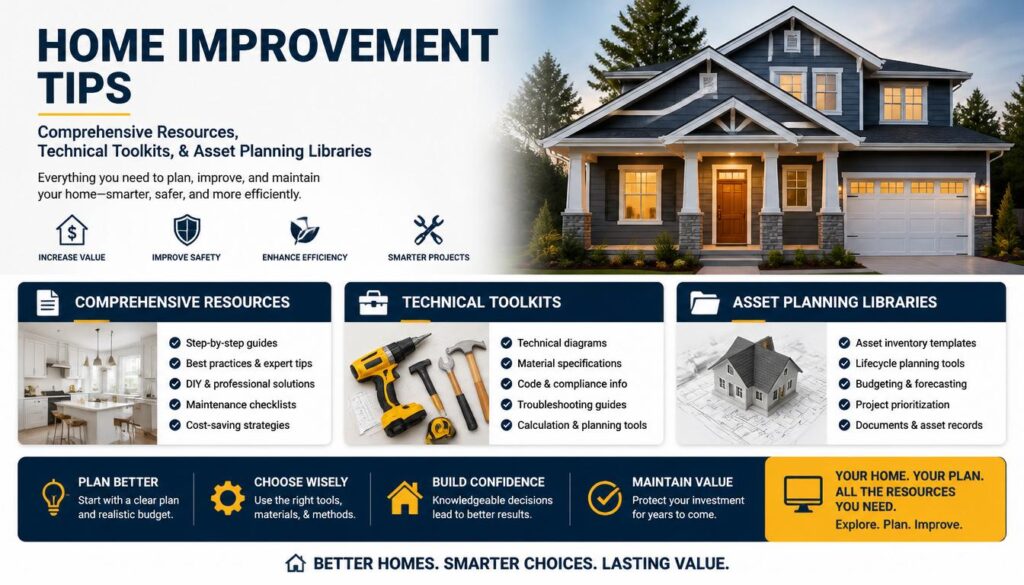
Explore the Home Improvement Journal. From micro-level insulation thermal imaging audits to macro-level neighborhood equity forecasting, our journal serves as your primary independent reference engine for modern residential asset management.
The Home Improvement Tips editorial desk has compiled this multi-tiered, professional-grade resource directory. Below, you will find our strictly vetted selection of industry-standard modeling software, official building code databases, architectural calculators, field diagnostic tools, and continuing trade education assets. We utilize and actively audit these exact resources to maintain the absolute technical accuracy of our publication’s six core content pillars.
1. Official Regulatory Frameworks & Building Code Databases
Before breaking ground, modifying a load-bearing assembly, or upgrading a residential mechanical layout, verifying national, municipal, and regional compliance mandates is non-negotiable. Building codes are not arbitrary suggestions; they are legally binding minimum standards established to ensure life safety, structural resilience, and fire prevention. We rely heavily on these primary regulatory bodies to anchor our architectural content:
The International Code Council (ICC)
The ICC is the global authority on building safety, responsible for drafting the codes adopted by the vast majority of jurisdictions worldwide. For residential property optimization, your primary reference point is the International Residential Code (IRC). This comprehensive manual governs all detached one- and two-family dwellings and townhouses up to three stories in height. Navigating the digital portal of the IRC allows engineers and contractors to verify strict compliance mandates regarding foundation depths, timber framing allowable spans, emergency egress dimensions, and fire-separation assemblies between adjacent living spaces.
The U.S. Department of Energy (DOE) & Energy Star Program
Modern asset management demands exceptional thermal efficiency. The DOE’s building science division, alongside the Energy Star Program, provides localized geographic climate zone mapping. These tools are critical for determining the exact R-value metrics required for your home’s building envelope. From evaluating the performance thresholds of low-E argon-insulated glazing units to calculating the target performance data for continuous external insulation slabs, this database ensures your property minimizes thermal bridging while complying with regional environmental mandates.
The National Fire Protection Association (NFPA)
Electrical infrastructure is the leading vector for residential fire hazards. To safely integrate smart technology, electric vehicle (EV) charging arrays, or whole-home solar distribution panels, you must adhere strictly to the National Electrical Code (NEC), managed by the NFPA. This regulatory archive provides granular blueprints regarding mandatory Arc-Fault Circuit Interrupter (AFCI) and Ground-Fault Circuit Interrupter (GFCI) protection zones, conduit fill ratios, service panel load capacities, and proper grounding electrode system routing.
2. Advanced Architectural, Civil Engineering, & Estimation Calculators
Precision math prevents structural deformation, minimizes material waste, and guards against commercial over-purchasing during the budgeting phase of a project. These highly specialized calibration engines help you verify complex trade metrics before signing a vendor contract or purchasing building supplies:
Structural Timber Beam & Joist Span Calibrators
When removing an interior partition or framing a new subfloor assembly, you must calculate the maximum allowable span of your horizontal structural members. These mathematical engines process variables including lumber species (such as Douglas Fir-Larch vs. Southern Yellow Pine), structural grade (No. 1, No. 2, or Select Structural), and expected live and dead loads ($lbs/ft^2$). Utilizing these calculators ensures that your headers, joists, and ceiling rafters are perfectly calibrated to resist deflection ($L/\Delta$) and bending moments under extreme real-world stress conditions.
Psychrometric & HVAC Manual-J Sizing Software
A home’s heating and cooling system should never be selected based on a rough guess of square footage. Oversized HVAC units cycles on and off rapidly, destroying the compressor and leaving humidity trapped in the air, while undersized units run constantly, spiking utility bills and wearing out components. Manual-J load calculations process localized weather data, wall orientations, continuous insulation values, window solar heat gain coefficients (SHGC), and internal heat loads. This ensures your heat pump, furnace, or ductless mini-split system is sized precisely to the BTU requirements of the property’s specific microclimate.
Concrete, Volumetric Soil, & Structural Aggregate Calculators
Sub-grade structural masonry requires dead-accurate volumetric ordering. Pouring an architectural slab, a retaining wall footing, or a frost-protected shallow foundation requires converting linear dimensions into exact cubic yardage while factoring in a standardized 5% to 10% waste margin. These calculation modules allow you to cross-reference total cubic volume with mandatory steel rebar reinforcement grids (such as #4 or #5 rebar spaced at specific on-center intervals), ensuring your concrete structures achieve their target compressive strength ratings (measured in PSI) without over-spending on batch trucks.
3. Spatial Design, Building Information Modeling (BIM), & Management Software
Modern asset optimization requires robust digital interfaces that allow you to plan, visualize, and stress-test an environmental modification before executing it in the physical world. We recommend these software ecosystems for serious spatial drafting and investment pipeline tracking:
SketchUp (Pro, Studio, and Web Interfaces)
SketchUp stands as an exceptionally agile and intuitive platform for preliminary 3D architectural modeling and spatial flow optimization. It allows authors, architects, and owners to mock up spatial concepts, evaluate daylighting profiles across different seasons, and map out rough furniture or cabinetry floorplans. Its robust extension warehouse allows for the integration of extension modules that can generate rough material cut-lists directly from your digital drawings.
Chief Architect Premium Premier
For professional-grade residential construction documentation, Chief Architect is an industry leader. Unlike basic drawing tools, this software operates as a true Building Information Modeling (BIM) system. When you place a wall in Chief Architect, the software automatically generates the underlying timber studs, drywall sheets, exterior sheathing layers, and insulation fills in the background. It outputs fully integrated blueprints, structural framing elevations, mechanical schematics, and realistic 3D renderings suitable for submittal to local municipal planning departments for building permit review.
OpenOS Property Systems & Asset Tracking Portals
For real estate syndicators, fix-and-flip investors, and multi-family property managers, treating physical spaces as financial assets requires dedicated tracking logic. These specialized database platforms allow you to monitor building depreciation cycles, manage preventative capital expenditure (CapEx) schedules (such as tracking the remaining lifespan of roofs, water heaters, and parking lot surfacing), log localized tenant maintenance pipelines, and accurately calculate your real-time cash-on-cash returns across an entire property portfolio.
4. Field Diagnostics, Material Science Instruments, & Telemetry
A trade professional or forensic home inspector is only as accurate as the diagnostic instruments they bring to the job site. To evaluate a property without tearing open walls, you should invest in or lease these advanced data-gathering tools:
FLIR High-Resolution Thermal Imaging Cameras
Infrared thermography is the ultimate tool for non-destructive forensic building science. By capturing the micro-delta variations in surface temperatures, a thermal imaging device allows you to instantly locate structural anomalies hidden completely behind finished drywall or siding.
- Insulation Audits: Instantly uncovers settling or missing fiberglass batts, loose-fill cellulose gaps, or broken continuous exterior foam boards.
- Moisture Detection: Wet building materials retain heat longer than dry ones; thermal cameras highlight hidden roof leaks, plumbing weeping, or foundation seeps as dark, cool anomalies.
- Electrical Hotspots: Identifies overloaded circuit breakers, loose wiring connections, or unbalanced three-phase configurations before they lead to an electrical fire.
Pin & Pinless Dual-Mode Moisture Meters
Water is the ultimate enemy of residential structural integrity. A dual-mode moisture meter allows you to verify the exact Moisture Content (MC %) of wood structural members, concrete subfloors, and interior gypsum boards. Pinless induction modes use electromagnetic signals to scan up to ¾ of an inch deep into structural timber or subfloors without damaging delicate finishes. If a problem area is identified, switching to resistance-based pin modes allows for precise data gathering at the exact source of intrusion, which is crucial for verifying that a space is fully dried out before installing premium hardwood flooring, tiling over a substrate, or closing up a wall cavity.
Laser Telemetry & Digital Inclinometers
Old-school bubble levels and tape measures introduce cumulative human errors across long layout runs. High-grade laser distance measures equipped with internal tilt sensors allow a single operator to measure long spatial runs with a precision of $\pm1/16$ of an inch over hundreds of feet. When paired with digital inclinometers, these tools are essential for mapping foundation settling, measuring precise roof pitches, verifying ADA-compliant slope runs for exterior access ramps, and confirming perfect level across major framing lines.
5. Continuing Trade Education, Research Papers, & Industry Journals
The world of residential architecture, building material science, and clean energy tech shifts rapidly. Staying ahead of supply chain developments, structural revisions, and emerging building sciences requires continuous reading of peer-reviewed trade journals. We suggest adding these elite resources to your weekly media consumption:
The Journal of Light Construction (JLC)
JLC is the premier publication for residential builders, remodelers, and hands-on general contractors. It eschews generic design trends in favor of real-world, field-tested construction techniques, intricate framing details, moisture management deep dives, and hard-hitting failure analyses. Reading JLC ensures you understand how to execute durable architectural details that resist the elements over decades of use.
Green Building Advisor (GBA)
For anyone deeply interested in the physics of building performance, GBA is the undisputed gold standard. This online think-tank features technical breakdowns from world-renowned building scientists focusing on vapor barrier configurations, continuous exterior insulation strategies, advanced air-sealing techniques, and the optimization of ultra-efficient net-zero or Passive House residential structures.
Fine Homebuilding Magazine
Blending master-level trade craftsmanship with modern architectural engineering, Fine Homebuilding provides exceptional visual and textual deep dives into custom residential builds. From mastering complex timber-roof rafter geometry to reviewing the newest innovations in high-performance weather-resistive barriers (WRB), this resource is built for professionals who refuse to cut corners.